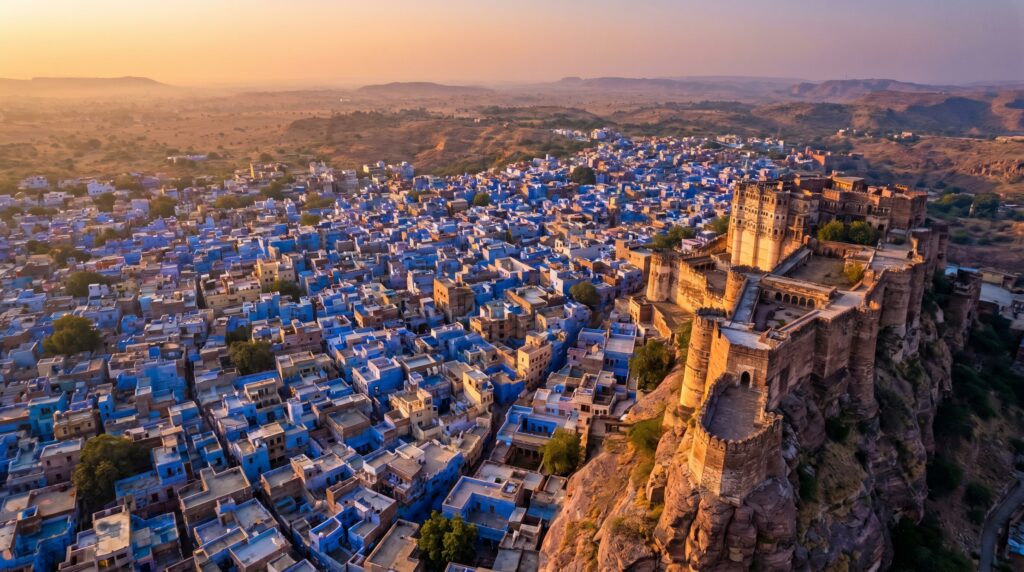
Standing atop the ramparts of Mehrangarh Fort, you’ll witness one of India’s most breathtaking spectacles — a vast ocean of indigo-painted rooftops stretching endlessly toward the horizon. Welcome to Jodhpur, Rajasthan’s legendary Blue City.
But have you ever wondered: why is Jodhpur called the Blue City? The answer isn’t just one story — it’s a fascinating tapestry of caste traditions, spiritual beliefs, scientific reasoning, and desert survival wisdom that spans over 500 years.
Nestled at the edge of the Thar Desert, Jodhpur is renowned for its stunning architecture, vibrant culture, and historical significance. The city’s distinctive skyline, adorned with myriad shades of blue, has captured the imagination of visitors worldwide.
In this comprehensive guide, we’ll uncover the true reasons behind Jodhpur’s blue identity and take you on a complete self-guided walking tour through the most stunning blue lanes of the old city.
🚖 Planning a trip to Jodhpur? Let Travels House Jodhpur handle your entire journey — from Jodhpur Airport taxi pickup to Jodhpur sightseeing tours, Jaisalmer desert tours, and complete Rajasthan packages. We are born and raised in Jodhpur — your most trusted local travel partner!
📌 Quick Navigation
- History of Jodhpur — The Blue City’s Origin
- Why is Jodhpur Called the Blue City? — 5 Theories
- Where to See the Blue Houses
- Blue City Walking Tour — Complete Route
- Food Stops During Your Walk
- Best Time to Visit
- The Blue City is Vanishing
- Essential Tips
- How to Get There — Book with Us
- FAQs
🏰 The History of Jodhpur — The Blue City’s Origins {#history}
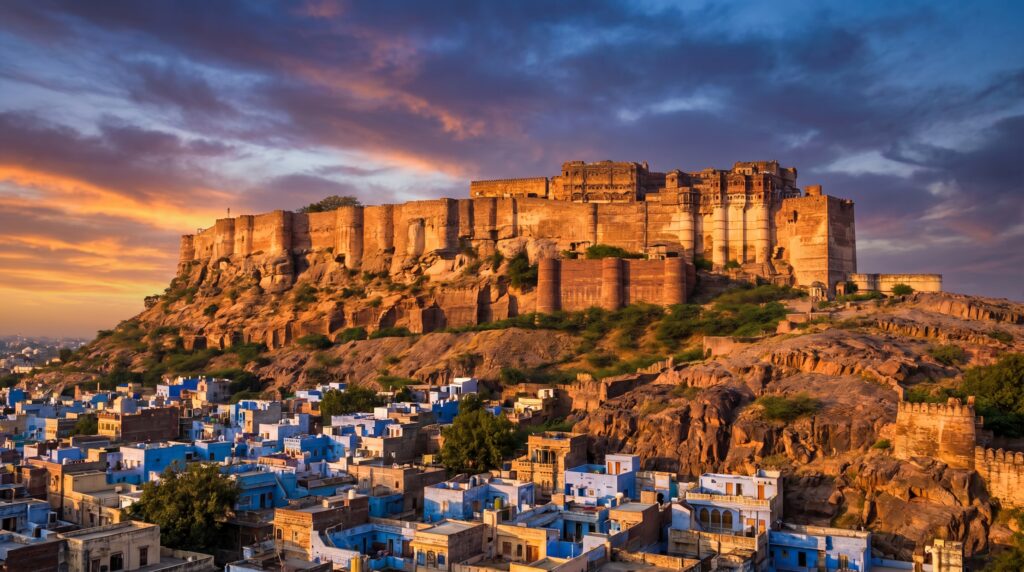
Jodhpur was founded by Rao Jodha, the Rajput chief of the Rathore clan in 1459 AD. Initially, the region was known as Marwar — meaning “the land of death” — but was later renamed Jodhpur in honor of its founder.
Towering dramatically above the city is the magnificent Mehrangarh Fort, one of the largest and most impressive forts in India. Built in 1459 by Rao Jodha, the fort stands proudly on a rocky hill 410 feet above the city, offering sweeping views of the indigo blue houses below.
The city expanded gradually around Mehrangarh Fort, and as Jodhpur lies almost at the geographical centre of Rajasthan, it became a strategic trading hub and a convenient base for travelers to explore the entire state.
Today, the second largest city in Rajasthan is one of India’s most photographed destinations — and its iconic blue color is the #1 reason why.
🔗 Explore Jodhpur’s majestic fort on your visit! Our full-day Jodhpur sightseeing tour covers Mehrangarh Fort, Umaid Bhawan Palace, Jaswant Thada, Gulab Sagar & the Blue City old lanes — all in a single comfortable day with an AC car and local expert driver.
🔵 Why is Jodhpur Called the Blue City? — 5 Fascinating Theories {#theories}
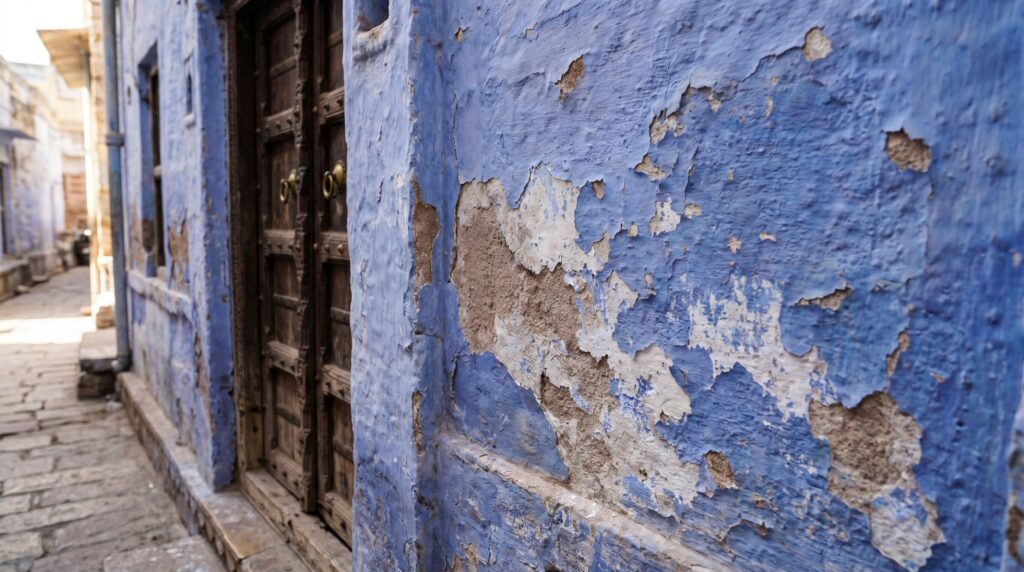
The nickname ‘Blue City’ carries an air of mystery and allure. The prevalence of the color blue in Jodhpur’s architecture is not merely an aesthetic choice — it is deeply rooted in the city’s history, culture, and spirituality. Understanding the origins of this distinctive color palette unveils a rich tapestry of traditions and influences.
Here are the 5 most widely accepted theories:
🔵 Theory 1: The Brahmin Caste Tradition
The genesis of Jodhpur’s ‘Blue City’ epithet traces back to the 15th century, when the Brahmins — the priestly class — began painting their houses blue as a means of distinction and to signify their elevated social status.
Over time, upper caste Brahmins painted their homes blue to distinguish their residences from those of other castes. This tradition is believed to have begun during the reign of Maharaja Man Singh in the 15th century.
The Brahmin class could afford copper sulphate lime washes, which were applied to their houses concentrated in one area of the city. It is thought that by choosing the royal blue color, they were emphasizing their connection to royalty — while in reality, they were simply the ones who could afford the specialist exterior paint.
🙏 Theory 2: Spiritual Significance of Blue in Hinduism
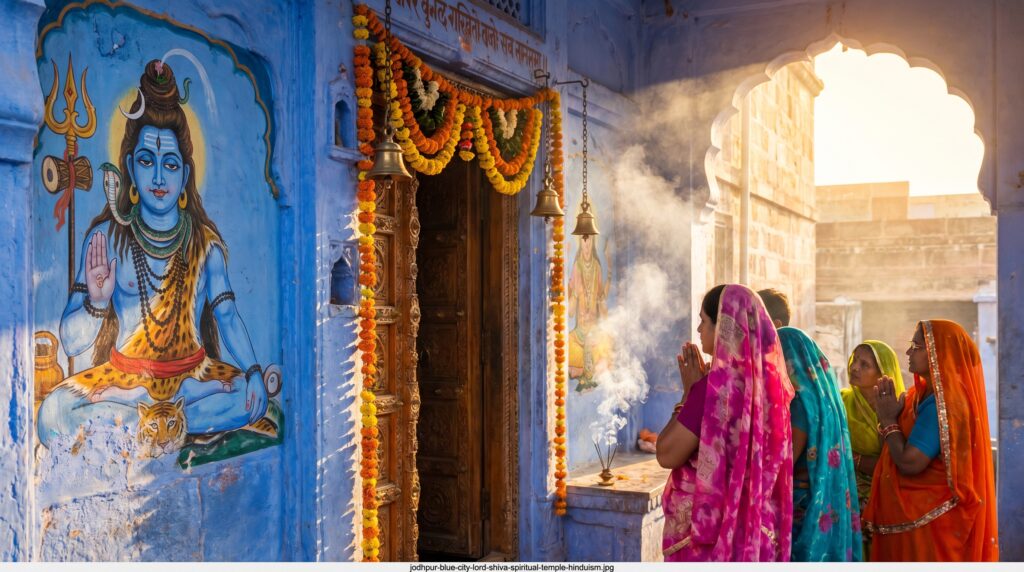
In Hinduism, the color blue holds a deeply sacred meaning. It is closely associated with beloved deities like Lord Krishna and Lord Shiva, symbolizing infinity, cosmic power, and divine calm. Many locals believe that painting homes blue is a way to connect with divine energy, bringing peace, stability, and spiritual balance to the household.
The specific connection to Lord Shiva is particularly powerful: According to the legend of Samudra Manthan (the churning of the cosmic ocean), Lord Shiva drank a deadly poison called Halahala to rescue the earth, which turned his throat and body blue. His devotees consider blue a divine color and honor him by painting their homes blue in devotion.
🐛 Theory 3: Protection from Termites
A third, more practical theory relates to survival in the desert environment. Due to Jodhpur’s hot and semi-arid climate, houses are highly susceptible to termite infestations, which can destroy walls and entire building structures.
People discovered that painting walls with a mixture of copper sulphate and limestone repelled these destructive insects. Copper sulphate under certain conditions turns a vivid blue — giving the houses their distinctive royal color while also protecting the buildings from termite damage.
☀️ Theory 4: Keeping Houses Cool in Desert Heat
Jodhpur is located at the edge of the Thar Desert and experiences blazing temperatures for most of the year — earning it the additional nickname of the “Sun City”. Blue is known to reflect sunlight more effectively than darker colors, which helps keep the interiors of homes cooler in the intense desert heat.
This highly practical advantage is one of the most logical reasons the color became so widely adopted among all classes of Jodhpur residents.
👑 Theory 5: The Royal Color of Power
In India, the color blue has long been associated with royalty, power, and prestige. The higher caste Brahmins, wishing to signal their standing and royal connections, chose blue as the color of their homes. Over time, as the tradition spread beyond the Brahmin quarter, the entire old city took on its now-famous indigo identity.
💡 The Real Answer? Why Jodhpur is called the Blue City is not just about color. It’s a story of caste history, religious belief, architectural resilience, scientific adaptation, and cultural pride — all woven into a single stunning shade of indigo.
👁️ Where to See the Blue Houses in Jodhpur {#where}
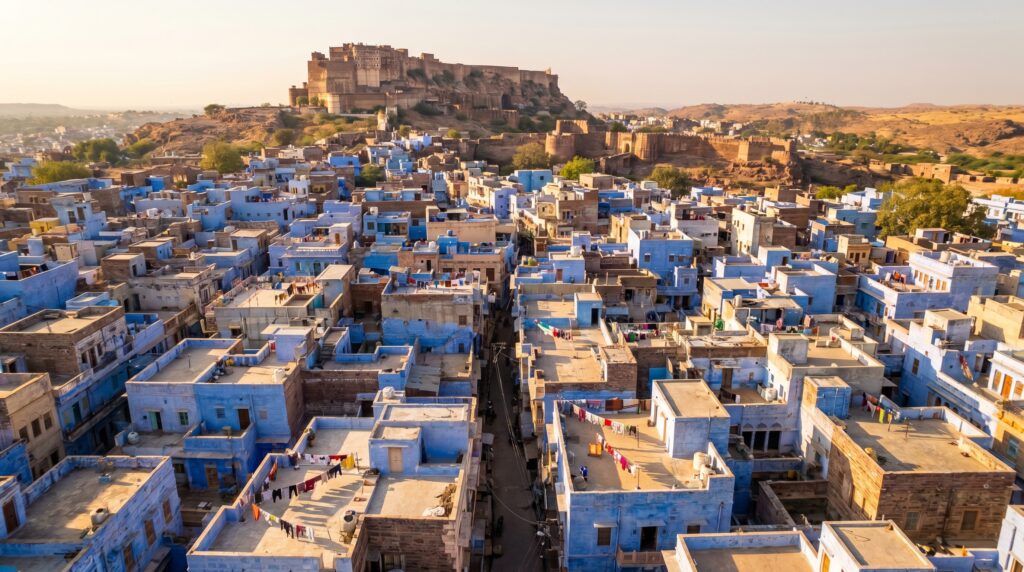
Not all of Jodhpur is painted blue — the iconic blue color is primarily concentrated in the old town area near Mehrangarh Fort. Standing atop the fort and gazing at the blue-patterned houses is one of the most spectacular photo opportunities in all of India.
The best blue neighborhoods to visit include:
- 🔵 Brahmpuri — The original Brahmin quarter and the true birthplace of the blue tradition. One of the prime attractions for tourists visiting Rajasthan.
- 🔵 Navchokiya — One of the most iconic neighborhoods: a beautiful maze of narrow lanes, bright doorways, and traditional homes that retain their heritage charm.
- 🔵 Old City Wall Area — Looking north from Mehrangarh Fort, clusters of blue houses stretch over 10 km along the fort wall, comprising the oldest part of the city outside the fort.
🚖 Pro Tip: Let Travels House Jodhpur drop you directly at the best starting points for your blue city walk and pick you up after — so you can focus entirely on exploring, photographing, and soaking in the magic! Book our Jodhpur local sightseeing cab today.
🚶 Blue City Walking Tour Jodhpur — Complete Self-Guided Route {#walkingtour}
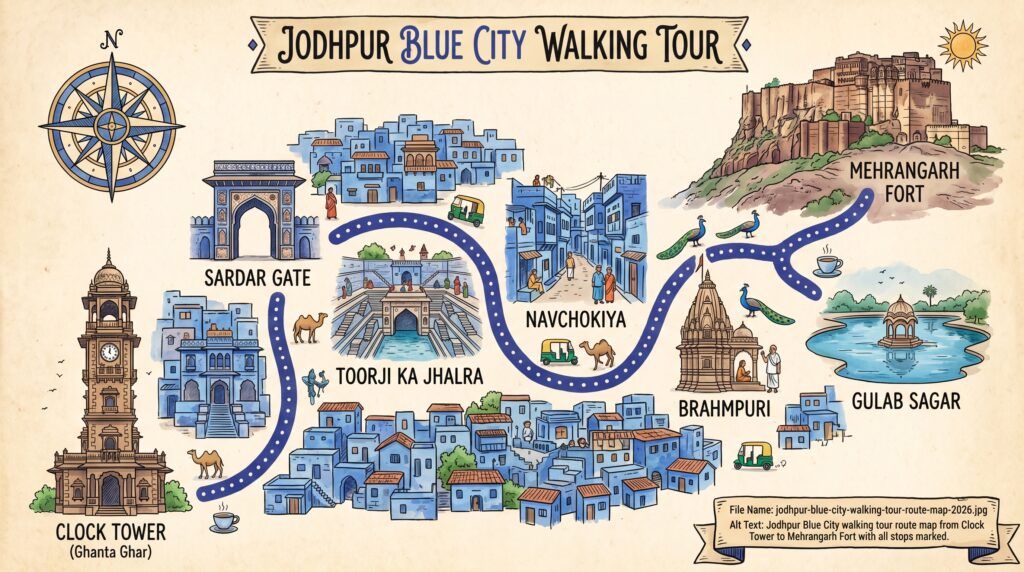
There’s no better way to experience Jodhpur than by wandering through its narrow lanes, soaking in the indigo hues, and watching daily life unfold around you. That said, the old city’s maze of twisting streets can be tricky to navigate — many lanes don’t appear on maps, and it’s easy to find yourself walking in circles.
Here’s a step-by-step walking route through the heart of the Blue City:
⏱️ Tour Details at a Glance
| Detail | Info |
|---|---|
| Duration | 2–3 hours (self-guided) / 3–4 hours with stops |
| Distance | ~3–4 km |
| Best Time | Early morning, 7–10 AM |
| Difficulty | Easy to Moderate |
| Best Season | October to March |
| Starting Point | Ghanta Ghar (Clock Tower) |
| Ending Point | Mehrangarh Fort / Jaswant Thada |
🔗 Want a guided experience? Skip the navigation stress! Our Jodhpur full-day sightseeing tour includes a knowledgeable local driver-guide, comfortable AC car, all major stops, and flexible timing. Book your tour here →
🛑 Stop 1: Ghanta Ghar (Clock Tower) — Starting Point
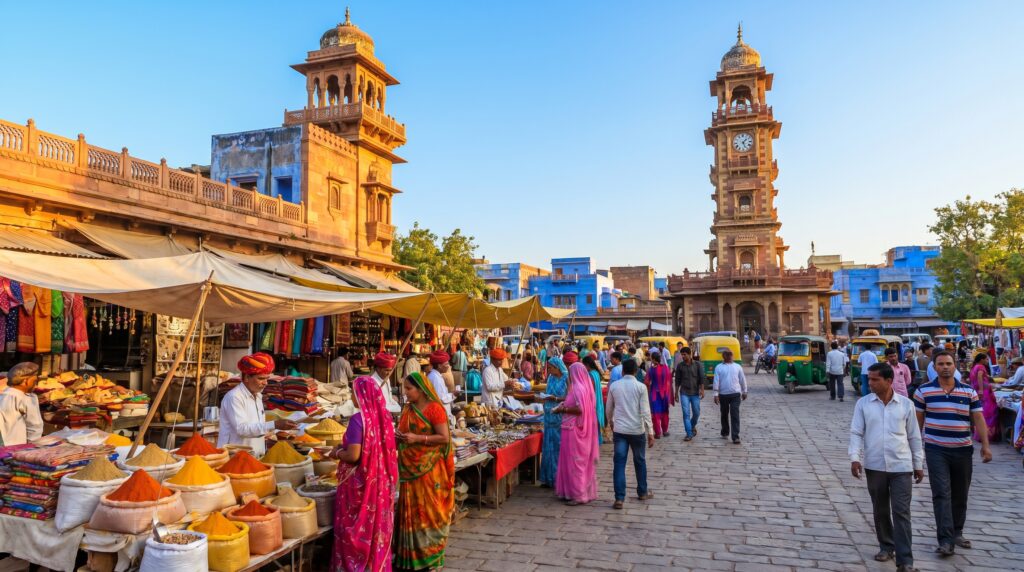
Begin early at Ghanta Ghar — the famous landmark clock tower at the very centre of the old city. Built between the late 19th and early 20th century, it is not only centrally located but also architecturally and historically fascinating.
The Sardar Market surrounding the tower is a bustling bazaar brimming with color — spices, textiles, Rajasthani handicrafts, silver jewellery, and colorful turbans. Spend 20–30 minutes here before beginning your walk.
🔗 Combine your Blue City walk with a complete Jodhpur day tour! Travels House Jodhpur offers full-day and half-day Jodhpur sightseeing packages covering all major landmarks — with a professional local driver who knows every hidden gem in the city.
🛑 Stop 2: Sardar Gate (Girdikot)
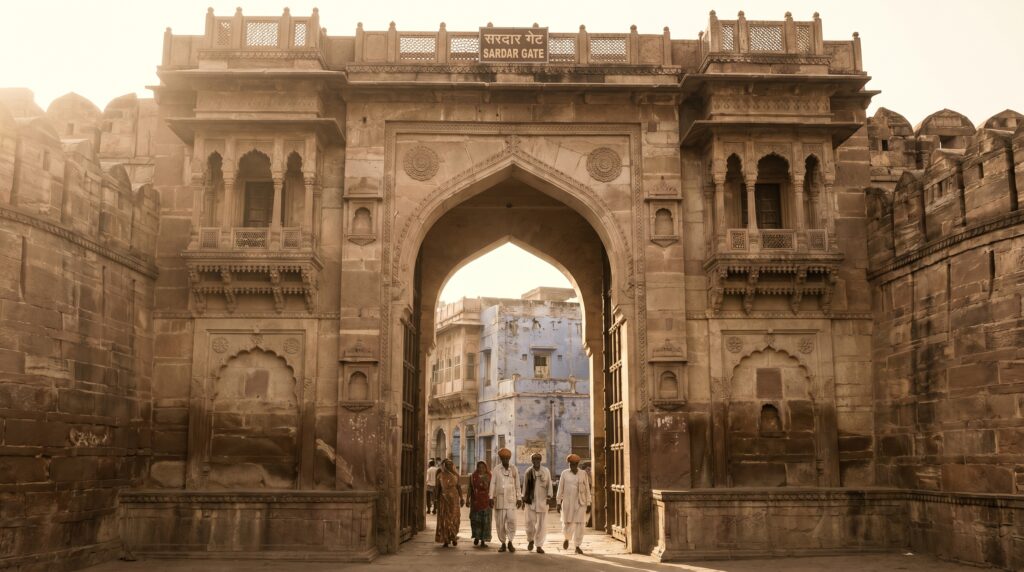
Just north of the clock tower stands Sardar Gate (Girdikot) — once the main ceremonial entrance to the walled old city. Historically, the gates opened at 5 AM and closed at midnight; anyone arriving late had to wait outside until morning. Today, even as new routes lead into the city, the gate remains an iconic gateway to Jodhpur’s most vibrant heritage quarter.
🛑 Stop 3: Toorji Ka Jhalra (Stepwell)
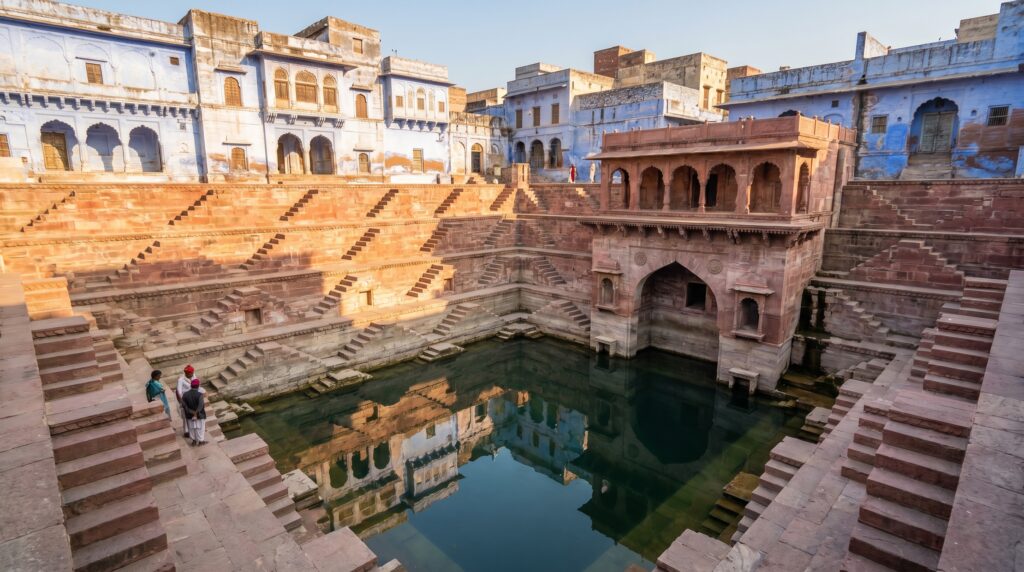
Head north to Toorji Ka Jhalra — one of Jodhpur’s most beautiful and photogenic stepwells. Built in 1740 from rose-red sandstone, it once served as the city’s primary water reservoir and now draws visitors for its extraordinary symmetrical geometric beauty.
This is arguably the most Instagram-worthy spot in all of Jodhpur — the reflection of the blue buildings in the still water is pure magic. Spend at least 15–20 minutes here.
🔗 Arriving in Jodhpur by flight? Book a seamless Jodhpur airport taxi with Travels House Jodhpur. We offer reliable airport pickups with flight tracking — no waiting, no stress, transparent pricing!
🛑 Stop 4: Navchokiya — Heart of the Blue City
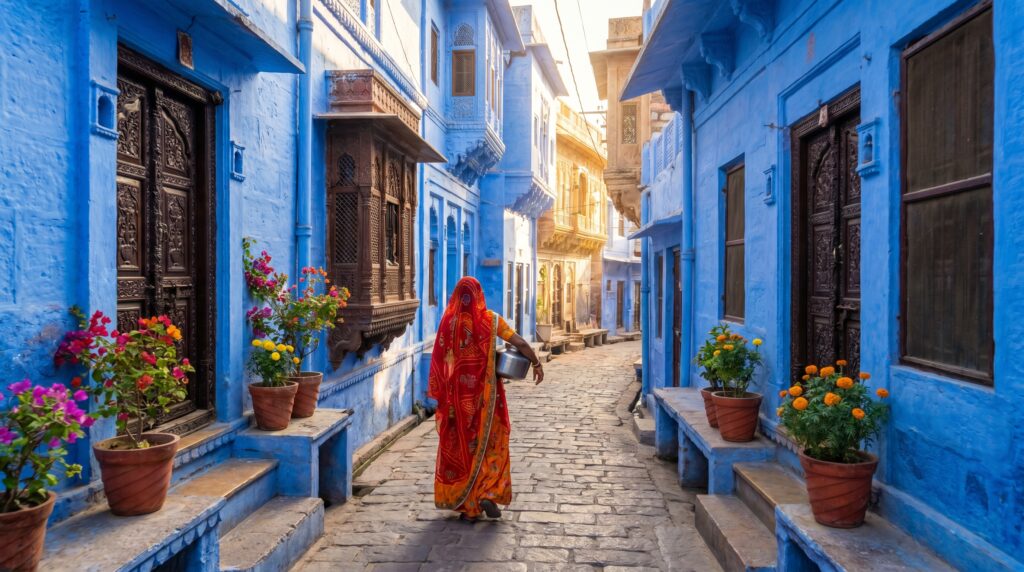
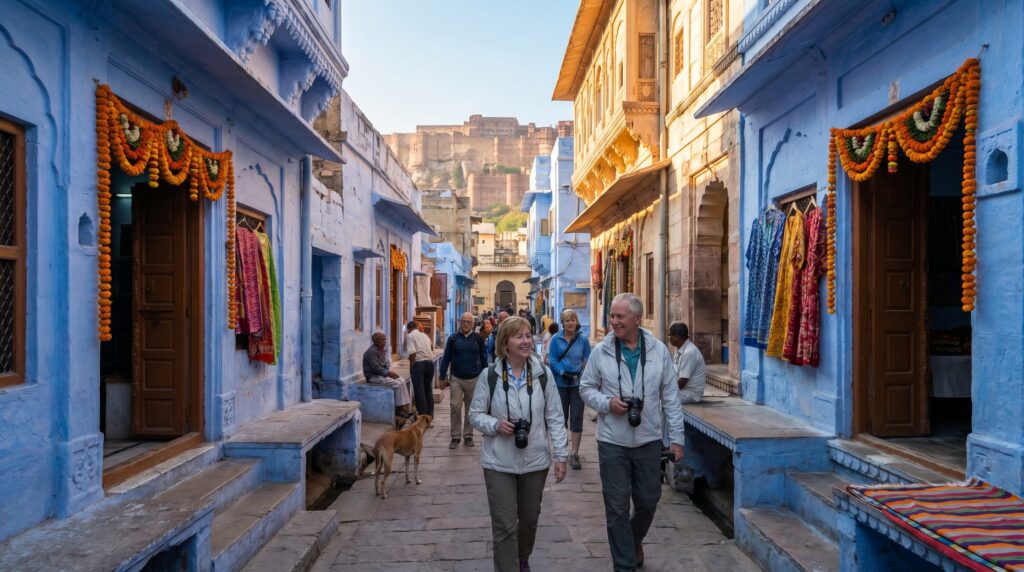
For an authentic local experience, stroll through Navchokiya — the living, breathing heart of Jodhpur’s blue-painted labyrinth. Away from the main tourist crowds, this neighborhood showcases the city’s everyday life and artistry in its truest form.
Here you’ll discover:
- 🏛️ Beautiful temples with blue-painted facades
- 🛍️ Busy local markets with spices and textiles
- 🎨 Instagram-worthy murals and imaginative street art
- 🪟 Famous blue Havelis with intricately carved windows
This is where you’ll witness the deepest, most vivid blue houses — with beautifully painted doorways, carved wooden windows, and the sounds of daily life echoing through indigo-painted alleys.
🛑 Stop 5: Brahmpuri — The Original Blue Neighborhood
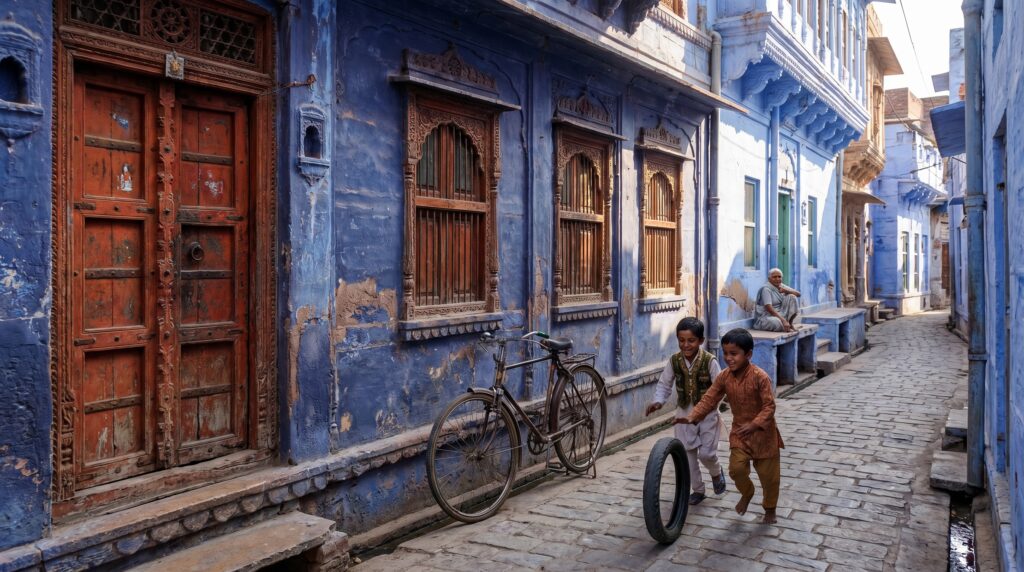
This is where it all began — the original Brahmin quarter where the tradition of painting houses blue first took root in the 15th century. Walk slowly through the winding lanes and look for:
- 🏠 Ancient blue havelis with ornate carved balconies
- 🛕 Hindu temples with vivid blue exteriors and bells
- 👗 Local women in vibrant Rajasthani attire posing against blue walls
- 👦 Children playing in the indigo-painted alleys
- 🎨 Hand-painted doorways in every hue of blue imaginable
🔗 Want to explore Jodhpur comfortably with a trusted local driver? Travels House Jodhpur provides comfortable sedans, spacious MUVs for families, and premium coaches for groups — all with professional, background-verified drivers. Book your Jodhpur sightseeing cab today →
🛑 Stop 6: Gulab Sagar Lake
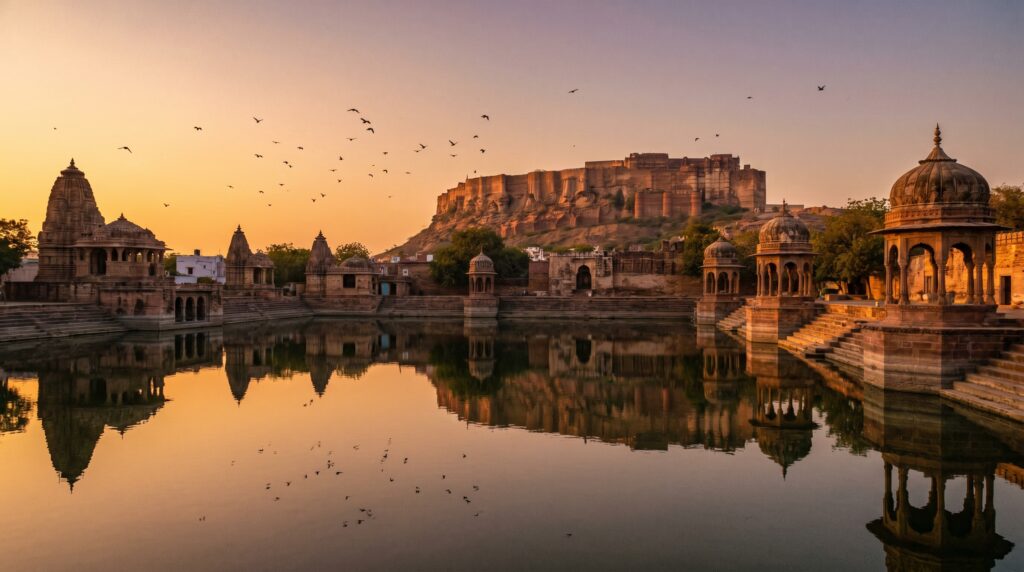
Gulab Sagar, an 18th-century lake, is a vital part of Jodhpur’s traditional water management system. This picturesque spot offers fantastic views of Mehrangarh Fort and is surrounded by intriguing stepwells and ancient temples.
Notable nearby sites include:
- 💧 Mahila Bagh Ka Jhalra — a beautiful historic stepwell
- 🛕 Kunjabihari Temple — dedicated to Lord Krishna
- 📸 Multiple incredible viewpoints of Mehrangarh Fort framed by water
🛑 Stop 7: Mehrangarh Fort — The Grand Finale 🏰
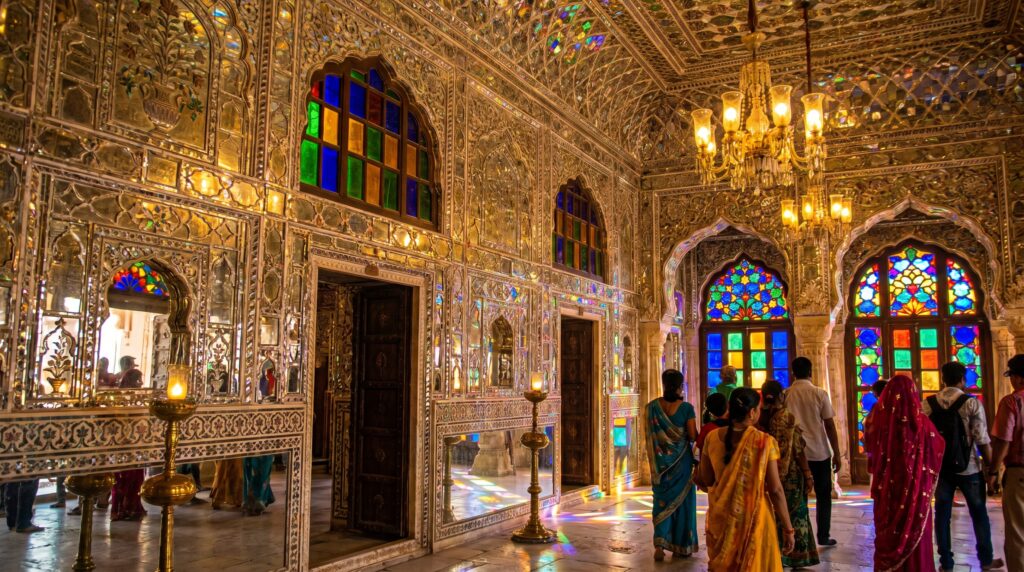
Built by Rao Jodha in 1459, this colossal structure is the crown jewel of Jodhpur — and the greatest vantage point from which to view the entire Blue City spread below. Inside, the Mehrangarh Museum houses an exceptional collection of royal artifacts including palanquins, armory, paintings, and royal costumes.
Must-see rooms inside the fort:
- 🪞 Sheesh Mahal (The Hall of Mirrors)
- 🌸 Phul Mahal (The Palace of Flowers)
- 👑 Moti Mahal (The Palace of Pearls)
- 🎭 Takhat Vilas — a royal bedroom with exquisite paintings
Additionally:
- 🎶 Enjoy cultural performances in the evenings
- 🍽️ Dine at the Chokelao Mahal Terrace restaurant with stunning sunset views
- 🪂 Experience the thrilling Jodhpur Flying Fox zipline around the fort walls for an adrenaline rush!
🔗 The best way to reach Mehrangarh Fort from anywhere in Jodhpur or from the airport is with a Travels House Jodhpur taxi. Book our Jodhpur sightseeing tour that covers Mehrangarh Fort, Umaid Bhawan Palace, Jaswant Thada, and the Blue City — all in one perfect day!
🛑 Stop 8: Jaswant Thada — The Taj Mahal of Marwar
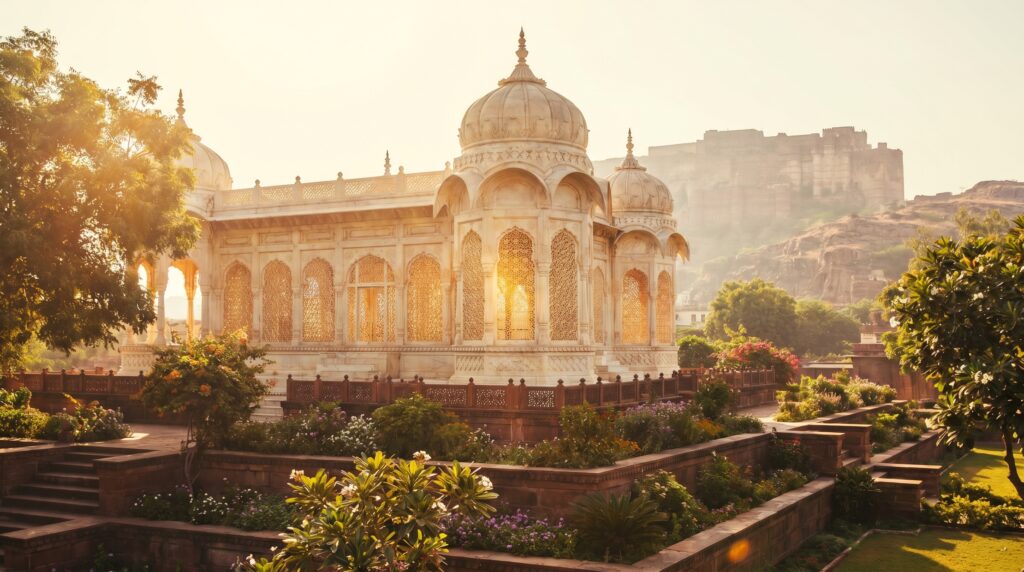
A short walk from Mehrangarh Fort lies Jaswant Thada — Jodhpur’s most serene and poetic monument, often called the “Taj Mahal of Marwar.”
Constructed in 1899 as a memorial to Maharaja Jaswant Singh II, this stunning white marble mausoleum features delicate lattice screens that glow golden in sunlight, ornate domes, and a peaceful garden with spectacular views of both the fort and the Blue City.
This is the perfect final stop — sit, breathe, reflect, and photograph the magical view of blue rooftops contrasted against white marble.
🍛 Food Stops During Your Walking Tour {#food}

No Blue City walk is complete without tasting Jodhpur’s legendary street food! The old city is a paradise for food lovers, with iconic local snacks available at nearly every corner.
| 🍽️ Food Item | 📍 Where to Try | 🛑 Near Stop |
|---|---|---|
| Mirchi Bada | Shahi Samosa near Clock Tower | Stop 1 |
| Mawa Kachori | Near Sardar Market stalls | Stop 1 |
| Masala Omelette Toast | The Omelette Shop (since 1974) | Stop 2 |
| Makhaniya Lassi | Lassi shops near Toorji Ka Jhalra | Stop 3 |
| Pyaaz Kachori | Various shops in old city lanes | Stop 4–5 |
| Chai & Local Sweets | Tea stalls in Brahmpuri | Stop 5 |
| Besan Ki Chakki | Halwai shops near Gulab Sagar | Stop 6 |
🔗 After your Blue City walk, extend your Rajasthan adventure! Explore the golden sands of Jaisalmer with our popular Jodhpur to Jaisalmer Tour Package — featuring desert forts, camel safaris, and overnight dune camping with cultural folk performances. Or discover the lake city with our Jodhpur to Udaipur outstation taxi — comfortable AC cars, transparent pricing, experienced drivers.
🗓️ Best Time to Walk the Blue City {#besttime}
| Month | Weather | Walking Experience |
|---|---|---|
| Oct – Feb ✅ | Cool & pleasant (10–25°C) | BEST TIME — perfect morning walks |
| Mar – May ⚠️ | Hot (25–45°C) | Start before 8 AM only, carry water |
| Jun – Sep 🌧️ | Monsoon, humid | Blue walls look vivid after rain but lanes can be slippery |
Special Events to Combine with Your Visit:
- 🎶 Jodhpur RIFF (Rajasthan International Folk Festival) — October
- 🪁 Jodhpur International Desert Kite Festival — January
- 🎭 Marwar Festival — September/October
🔗 Planning your Rajasthan holiday? Travels House Jodhpur offers customized Rajasthan tour packages covering Jodhpur, Jaisalmer, Jaipur, and Udaipur — with comfortable AC cars, experienced local drivers, and completely transparent pricing. Get your custom quote today →
🏚️ The Blue City is Vanishing — Why Preservation Matters {#preservation}
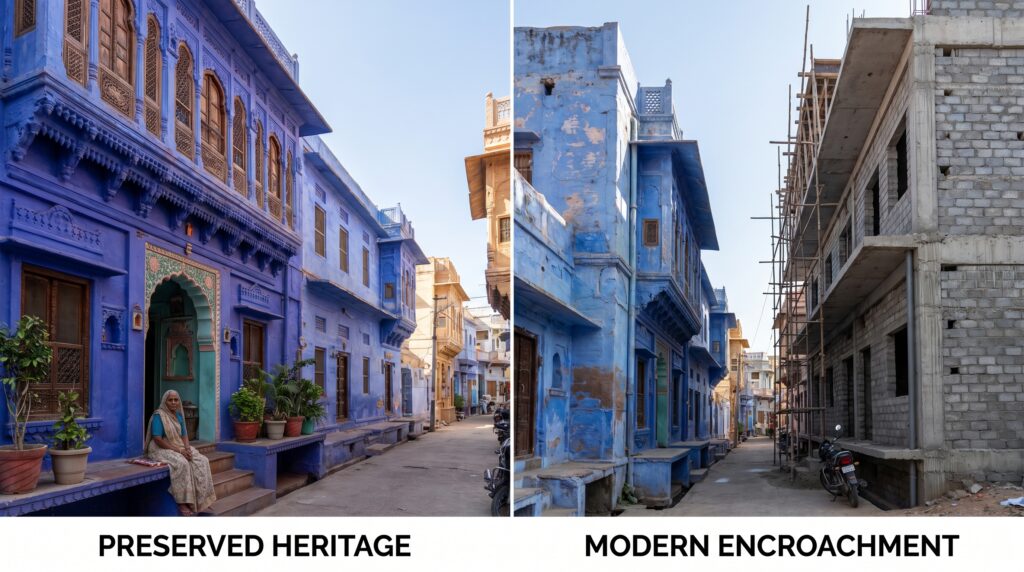
In recent years, Jodhpur’s distinctive blue identity has been gradually disappearing. Modernization and urban development have taken precedence, with newer generations opting for contemporary architectural styles and neutral colors. New constructions and renovations have slowly diluted the sea of blue. Additionally, the traditional practice of using natural indigo dye and copper sulphate lime wash has been replaced with modern, less vibrant commercial paints.
In response, conservation efforts are underway. Local authorities and heritage preservation groups have initiated campaigns to encourage residents to repaint their homes blue. Tourism plays a significant role in raising awareness — efforts to preserve the blue houses are often tied directly to promoting cultural tourism, giving locals economic incentive to maintain their blue-painted homes.
Your visit helps! Every tourist who walks through the Blue City, photographs it, and shares their experience online contributes to preserving this irreplaceable living heritage.
✅ Essential Walking Tour Tips {#tips}
- 🌅 Start early — Before 8 AM for the best golden light and fewer crowds
- 👟 Wear comfortable shoes — Lanes are uneven, narrow, and sometimes slippery
- 💧 Carry water — Especially essential in warmer months (March–May)
- 📸 Ask before photographing locals — Always be respectful of privacy
- 🗣️ Hire a local guide — For the deepest insights into hidden temples and secret lanes
- 🔋 Keep your phone charged — You will take hundreds of photos, guaranteed!
- 💵 Bring small change — For chai, street food, and tipping local vendors
- 🌤️ Wear light, breathable clothing — Cotton is best for Rajasthan’s climate
- 🧴 Apply sunscreen — Even in winter, the Rajasthan sun is strong
- 🚕 Book your return transport — Don’t get stranded! Travels House Jodhpur offers on-call taxi service throughout the day.
🚗 How to Get There — Our Complete Transport Services {#transport}
Whether you’re arriving at Jodhpur Airport, traveling from Jaipur, Udaipur, or Jaisalmer, or need a reliable local taxi for your sightseeing — Travels House Jodhpur has you fully covered.
| 🚖 Service | 📋 Details | 🔗 Book Now |
|---|---|---|
| ✈️ Airport Taxi Jodhpur | Reliable pickups & drops at Jodhpur Airport with real-time flight tracking | Book Airport Transfer → |
| 🏙️ Jodhpur Sightseeing Tour | Blue City + Mehrangarh Fort + Umaid Bhawan + Jaswant Thada | Book City Tour → |
| 🏜️ Jodhpur to Jaisalmer Tour | Desert forts, camel safari, dune camping, Golden Fort | Book Jaisalmer Tour → |
| 🏖️ Jodhpur to Udaipur Taxi | Comfortable outstation travel, Lake City sightseeing | Book Udaipur Trip → |
| 🏯 Jodhpur to Jaipur Taxi | Pink City outstation, Amber Fort, Hawa Mahal | Book Jaipur Trip → |
| 🗺️ Rajasthan Tour Packages | Multi-day Jodhpur + Jaisalmer + Jaipur + Udaipur circuit | View All Packages → |
| 👔 Corporate Chauffeur Service | Professional business travel, executive cars | Book Corporate Car → |
| 🚌 Group / MUV Booking | Spacious vehicles for families & groups with push-back seats | Book Group Vehicle → |
💚 Why Choose Travels House Jodhpur?
✅ Born and raised in Jodhpur — we know every hidden gem, local restaurant, and secret viewpoint tourists rarely discover ✅ 10+ years of experience crafting perfect itineraries across the desert state — from Jaisalmer dunes to Udaipur lakes ✅ Background-verified professional drivers with extensive knowledge of local routes and culture ✅ Personalized experiences tailored to your interests, pace, and budget ✅ Round-the-clock assistance — one call and we’re there for you 24/7 ✅ No hidden charges — what we quote is exactly what you pay, with a complete breakdown upfront
❓ Frequently Asked Questions (FAQ) {#faqs}
💡 Enable the Yoast FAQ Schema Block in WordPress for this section — this gives you rich FAQ snippets in Google search results, boosting your click-through rate significantly!
Q: Why is Jodhpur called the Blue City?
A: Jodhpur is called the Blue City because the houses in the old town area near Mehrangarh Fort are painted in vivid shades of blue. The tradition dates back to the 15th century when Brahmin priests painted their homes blue to signify social status, and the color later spread for additional reasons: repelling termites, keeping homes cool in the desert heat, and honoring Lord Shiva. Today, the Blue City is one of Rajasthan’s — and India’s — most iconic sights.
Q: Is all of Jodhpur painted blue?
A: No — blue houses comprise approximately 30% of the entire city. The blue color is mainly concentrated in the old town area near Brahmpuri and Navchokiya, close to Mehrangarh Fort. Other parts of the city are modern and have standard construction.
Q: What is the best time to visit the Blue City?
A: The best time to visit is between October and February, when the weather is cool and pleasant. For the walking tour specifically, start before 8 AM for the best light, comfortable temperatures, and fewer tourists in the lanes.
Q: How long does the Blue City walking tour take?
A: A self-guided walk takes approximately 2–3 hours. With a local guide, food stops, shopping, and photography, plan for 3–4 hours. A full day with Mehrangarh Fort entry can take 5–6 hours.
Q: Where is the best viewpoint to see the Blue City?
A: The most breathtaking view is from the ramparts of Mehrangarh Fort, where thousands of tightly packed homes painted in every shade of blue stretch to the horizon. The fort rises majestically 410 feet above the city. Sunrise and sunset are the best times for photography.
Q: How can I book a Jodhpur sightseeing tour or airport taxi?
A: Simply visit travelshousejodhpur.com to book your airport taxi, Jodhpur sightseeing tour, Jaisalmer tour package, or complete Rajasthan tour. We offer transparent pricing, AC vehicles, and local expert drivers — 10+ years serving tourists in Jodhpur.
Q: Can I combine the Blue City walk with a Jaisalmer desert tour?
A: Absolutely! Many visitors spend 1–2 days in Jodhpur exploring the Blue City, Mehrangarh Fort, and Umaid Bhawan Palace, then travel to Jaisalmer for the desert experience. Travels House Jodhpur offers a seamless Jodhpur to Jaisalmer tour package with comfortable road transfers and customizable itineraries.
🏁 Conclusion — Experience the Blue City with Travels House Jodhpur
From its centuries-old forts and palaces to its indigo-painted lanes and vibrant markets, Jodhpur is one of Rajasthan’s most captivating destinations. The blend of history, architecture, color, and cuisine makes the Blue City far more than just a nickname — it’s a complete, unforgettable experience.
Whether you’re a photographer chasing perfect frames, a history buff tracing Rajput heritage, a food lover exploring ancient bazaars, or simply someone who wants to wander through one of the world’s most colorful cities — the Blue City of Jodhpur will leave you absolutely spellbound.
Ready to experience the Blue City? Let Travels House Jodhpur be your trusted travel partner throughout Rajasthan.
✅ Book Jodhpur Airport Taxi ✅ Book Jodhpur Sightseeing Tour ✅ Book Jodhpur to Jaisalmer Tour ✅ Book Jodhpur to Udaipur / Jaipur Outstation Taxi ✅ View All Rajasthan Tour Packages
📞 Book Your Jodhpur Tour Today → travelshousejodhpur.com
Your journey begins the moment you land. We’ll take care of everything else.